
 English
  中文简体
中文简体


How to Optimize Your Disposable Food Container Supply Chain for Maximum Efficiency?
May 29, 2026
Content
- 1 Procurement Strategy Differences Between Delivery Food Container and Takeaway Food Container
- 2 Disposable Food Container Production Processes: Injection Molding vs. Thermoforming
- 3 Food Packaging Box Design Psychology: How Color and Shape Influence Consumer Decisions
- 4 Disposable Packaging Inventory Management: JIT vs. VMI Practice Comparison
- 5 Disposable Cup and Plastic Cup Custom Printing Technology Analysis
- 6 Paper Meal Box Moisture Resistance and Cold Chain Compatibility
- 7 Disposable Tableware Hygiene Safety and Microbial Control
- 8 Fast Food Packaging Automated Filling Compatibility Design
- 9 One Time Use Containers Carbon Footprint Accounting and Reduction Pathways
- 10 Implementation Pathways and Key Success Factors for Supply Chain Optimization
For food service enterprises and food manufacturers, wholesale disposable food container procurement decisions directly impact operational costs and customer experience. Unlike single-item purchasing, wholesale models require businesses to establish systematic supply chain management from four dimensions: supplier screening, inventory management, logistics coordination, and quality traceability. Data shows that optimized wholesale disposable food container supply chains can reduce packaging costs as a percentage of total revenue from an average of 8.5% to 5.2%, while decreasing inventory backlog by approximately 30%.
Procurement Strategy Differences Between Delivery Food Container and Takeaway Food Container
Although delivery food container and takeaway food container overlap functionally, their procurement logic differs significantly. Delivery food containers emphasize leak-proof sealing and temperature retention, typically requiring pairing with insulated bags or heating pads. Takeaway food containers, conversely, prioritize portability and visual presentation, as consumers usually pick up orders in-store and demand immediate packaging experience quality.
Key Parameters for Procurement Decisions
When procuring delivery food containers and takeaway food containers, enterprises should focus on the following parameters:
- Delivery radius: Businesses with delivery distances exceeding 5 kilometers should prioritize delivery food containers with double-layer sealing structures, keeping soup leakage rates below 2%
- Brand display requirements: The lid surface area and print compatibility of takeaway food containers directly impact brand exposure. Transparent PET materials supporting four-color printing are recommended
- Order volatility: Food delivery orders exhibit obvious peak periods. Wholesale procurement should maintain 20% to 30% safety stock to avoid service disruptions due to stockouts
Disposable Food Container Production Processes: Injection Molding vs. Thermoforming
The mainstream production processes for disposable food containers include injection molding and thermoforming. Injection molding suits structurally complex containers with uniform wall thickness, such as round containers with locking mechanisms. Thermoforming is better suited for high-volume production of thin-walled shallow products like fast-food trays and salad boxes.
| Process Type | Wall Thickness Range | Minimum Order | Tooling Cost | Cycle Time |
|---|---|---|---|---|
| Injection Molding | 0.4mm ~ 1.2mm | 5,000 units | High | 15 ~ 25 sec/unit |
| Thermoforming | 0.2mm ~ 0.6mm | 50,000 units | Low | 3 ~ 8 sec/unit |
For small-to-medium batch, multi-SKU disposable food container orders, injection molding offers greater flexibility. For highly standardized, high-volume single items, thermoforming holds approximately 25% unit cost advantage. Buyers should select matching production processes based on their order characteristics.
Food Packaging Box Design Psychology: How Color and Shape Influence Consumer Decisions
Food packaging boxes are not merely functional containers but the first touchpoint between brands and consumers. Consumer psychology research indicates that packaging color, shape, and opening mechanism significantly influence perceptions of food quality and brand value.
Color Perception and Appetite Association
Different colored food packaging boxes trigger distinct consumer psychological responses:
- White/Transparent: Conveys clean, minimalist brand imagery, suitable for healthy light meals and premium salad brands. Transparent PET food packaging boxes allow consumers to directly see food freshness, enhancing trust
- Black: Creates a premium, mysterious atmosphere, commonly seen in Japanese cuisine and specialty coffee packaging. Black food packaging boxes make food colors more vivid, enhancing visual impact
- Kraft paper natural color: Emphasizes natural, eco-friendly brand concepts, suitable for organic food and farm-to-table restaurants. Kraft paper food packaging box texture can improve brand favorability by approximately 18%
- Brand custom colors: Pantone-matched printing consistent with brand VI systems enhances brand recognition. Research shows chain brands with unified packaging colors achieve 34% higher customer recall than brands without unified packaging
Shape Design and User Experience
Food packaging box opening mechanisms directly impact consumer satisfaction. Traditional snap-on lids require two-handed operation, while the increasingly popular easy-tear strip design enables one-handed opening, particularly practical for commuting scenarios. Additionally, food packaging boxes with breathable vents prevent fried foods from softening due to steam accumulation, extending crispness retention by approximately 20 minutes.
Disposable Packaging Inventory Management: JIT vs. VMI Practice Comparison
Disposable packaging, as essential consumables for food service businesses, directly impacts cash flow and warehousing costs through its inventory management model. Current mainstream inventory management models include JIT (Just-In-Time) and VMI (Vendor Managed Inventory).
JIT Model: Low Inventory, High Turnover
The JIT model requires disposable packaging suppliers to maintain rapid response capabilities, with order-to-delivery cycles typically controlled within 48 hours. This model suits food service brands with high order volatility and numerous SKUs, compressing inventory turnover days from the traditional 30 days to 7 days. However, JIT places extremely high demands on supply chain stability; once suppliers encounter capacity bottlenecks, stockout risks arise immediately.
VMI Model: Risk Sharing and Collaborative Forecasting
Under the VMI model, suppliers directly manage customers' disposable packaging inventory, automatically replenishing based on real-time sales data. This model shifts inventory risk from buyers to suppliers while achieving more accurate demand forecasting through data sharing. Food service enterprises implementing VMI experience average disposable packaging stockout rate reductions of 60%, but require deep information system integration between both parties.
| Dimension | JIT Model | VMI Model |
|---|---|---|
| Inventory Turnover Days | 5 ~ 10 days | 15 ~ 25 days |
| Stockout Risk | Higher | Lower |
| IT System Requirements | Medium | High |
| Supplier Relationship | Transactional | Strategic Partnership |
| Suitable Enterprise Scale | Small-to-medium restaurants | Large chain brands |
Disposable Cup and Plastic Cup Custom Printing Technology Analysis
In the increasingly competitive beverage market, custom printing on disposable cups and plastic cups has become a crucial means of brand differentiation. Mainstream printing technologies include screen printing, offset printing, and in-mold labeling (IML), each with applicable scenarios and cost structures.
Printing Technology Selection Guide
Different printing technologies yield significantly different results on disposable cups and plastic cups:
- Screen printing: Suitable for small-batch, multi-color plastic cup customization, with low per-unit printing costs but limited color gradient effects. Ideal for seasonal promotions and limited-edition beverage cups
- Offset printing: Suitable for high-volume disposable cup production, capable of photo-quality printing precision, but typically requires minimum orders of 100,000 units or more. Ideal for chain brands' regular packaging
- In-mold labeling (IML): Embeds pre-printed labels directly into plastic cup walls during injection molding, offering exceptional abrasion and water resistance, but with higher tooling costs. Suitable for premium brands requiring long-term print integrity
Notably, as digital printing technology matures, small-batch, personalized disposable cup and plastic cup customization costs are rapidly declining. Some manufacturers now offer full-color digital printing with minimum orders as low as 500 units, providing small and medium brands with packaging customization capabilities comparable to major brands.
Paper Meal Box Moisture Resistance and Cold Chain Compatibility
Paper meal boxes are experiencing rapid growth in cold chain delivery applications, but their natural hygroscopicity has long been a technical challenge. Untreated paper meal boxes lose approximately 40% of their strength within 30 minutes in high-humidity environments, leading to deformation or damage.
Composite Moisture-Resistant Technology Solutions
Current mainstream paper meal box moisture-resistant technologies include:
- PE lamination: Compositing a polyethylene film layer on the paper substrate surface offers optimal moisture resistance but affects recyclability. PE-laminated paper meal boxes maintain structural integrity in refrigerated environments for over 48 hours
- PLA lamination: Using polylactic acid instead of PE provides both moisture resistance and compostable degradation characteristics, representing the most eco-friendly paper meal box moisture-resistant solution, but costs approximately 35% more than PE lamination
- Water-based barrier coating: Directly applying nano-scale barrier layers onto paper fibers without altering recyclability, but with relatively shorter moisture protection duration, suitable for short-distance delivery scenarios
For cold chain food service brands requiring delivery radii exceeding 2 hours, PE or PLA-laminated paper meal boxes are recommended, paired with ice packs to ensure food remains within safe temperature ranges upon delivery.
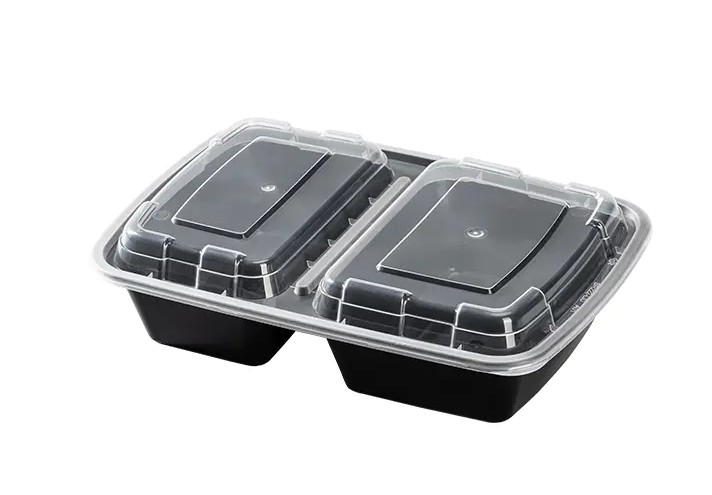
Disposable Tableware Hygiene Safety and Microbial Control
Disposable tableware hygiene safety is the lifeline of food service enterprises. Although disposable products theoretically avoid cross-contamination, microbial contamination can still occur during production, transportation, and warehousing.
Cleanliness Control in Production
High-quality disposable tableware production should occur in ISO Class 8 or higher cleanrooms, with airborne particle counts controlled below 3,520,000 particles per cubic meter (≥0.5μm particles). Additionally, production water must meet purified water standards with conductivity below 5μS/cm to prevent mineral residue from affecting product hygiene indicators.
Warehousing and Transportation Temperature/Humidity Management
Disposable tableware should be stored away from floors and walls in well-ventilated, dry conditions. Recommended warehousing temperatures range from 15°C to 25°C with relative humidity below 60%. During transportation, avoid mixing with chemicals or odorous items to prevent cross-contamination. Individually sealed disposable tableware can reduce transportation contamination risks by approximately 80%.
Fast Food Packaging Automated Filling Compatibility Design
Fast food packaging design must consider not only consumer experience but also compatibility with automated filling production lines. As labor costs rise in the fast-food industry, an increasing number of chain brands are introducing automatic portioning equipment, placing strict requirements on packaging geometric precision and opening dimensions.
Key Design Parameters for Automation Compatibility
Fast food packaging suitable for automated filling should meet the following conditions:
- Standardized opening diameters: Automated filling nozzles have standard diameters of 80mm, 100mm, and 120mm. Fast food packaging opening sizes should match filling nozzles with deviations controlled within ±1mm
- Bottom stability: Container bottoms require anti-slip textures or flat-bottom structures to ensure stable operation on conveyor belts, with tipping rates below 0.5%
- Lid compatibility: Automated capping equipment requires lid-to-container fit tolerances within ±0.3mm. Too loose causes sealing failure; too tight increases capping machine malfunction rates
- Nesting ratio: Empty container nesting ratios must reach 1:3 or higher to reduce warehousing space occupancy and transportation frequency
Fast food packaging suppliers with automated compatibility design capabilities can help food service brands improve portioning efficiency by over 40% while reducing equipment downtime caused by packaging incompatibility.
One Time Use Containers Carbon Footprint Accounting and Reduction Pathways
In the global carbon neutrality context, full lifecycle carbon footprint accounting for one time use containers is becoming a mandatory procurement criterion for large food service groups and multinational retailers. From raw material extraction, production processing, transportation and distribution to final disposal, each stage generates corresponding carbon emissions.
Carbon Footprint Hotspot Analysis
According to Life Cycle Assessment (LCA) data, one time use containers carbon footprint distribution is as follows:
| Lifecycle Stage | Carbon Emission Share | Reduction Potential |
|---|---|---|
| Raw Material Production | 52% | rPP or bio-based materials reduce 30% ~ 45% |
| Processing Manufacturing | 28% | Renewable energy reduces 20% ~ 35% |
| Transportation Distribution | 15% | Optimized logistics reduce 15% ~ 25% |
| End-of-Life Disposal | 5% | Recycling reduces 40% ~ 60% |
Raw material production represents the largest source of one time use containers carbon footprint at 52%. Therefore, using recycled or bio-based materials is the most effective emission reduction pathway. Some leading one time use containers manufacturers have already achieved 100% renewable energy-powered production facilities, reducing processing-stage carbon emissions by approximately 30%.
Implementation Pathways and Key Success Factors for Supply Chain Optimization
Synthesizing the above analysis, optimizing wholesale disposable food container and related category supply chains requires enterprises to simultaneously advance in five dimensions:
- Supplier tiered management: Establish a dual-track mechanism with core suppliers (70% of procurement volume) and backup suppliers (30%), reducing single-dependency risks
- Digital demand forecasting: Utilize historical sales data and machine learning algorithms to improve disposable packaging demand forecast accuracy from the traditional 65% to over 85%
- Quality forward control: Implement incoming inspection and process audits at supplier sites, shifting quality issue discovery from pre-warehousing to production stages, reducing return rates
- Green procurement metrics: Incorporate carbon footprint, recycled material ratios, and environmental certifications into supplier evaluation systems, driving overall supply chain green upgrading
- Collaborative innovation mechanisms: Build joint development teams with disposable food container suppliers to create customized packaging solutions for specific dishes or scenarios, forming differentiated competitive barriers
As the disposable food packaging industry transitions from "cost-oriented" to "value-oriented" approaches, supply chain management capability will become an important component of food service enterprises' core competitiveness. Those businesses capable of elevating procurement of delivery food containers, takeaway food containers, disposable cups, paper meal boxes, and disposable tableware from mere transactional behavior to strategic collaborative relationships will gain significant advantages in future market competition.
Share:
Related Products
We are very glad that you came to JIEYU to purchase or customize, and we are confident to provide you with quality products and services.

We are committed to developing innovative, reliable, economical, and environmentally friendly disposable and reusable food service products for our customers.

No.199 Liansheng Road, Coast Business Center, Yinzhou District, Ningbo, Zhejiang, China

+86-18106622299

jay@jieyuplast.com
