
 English
 中文简体


2 Compartment Snack Containers: Practical Sizing, Lid Fit and Bulk Buying Guide
Nov 27, 2026
Content
Two-compartment snack containers fail for a boring, predictable reason: the filled volume does not match the split, or the lid never truly seals over the wet side. Colour, wall thickness and ripple finishes matter, but they are secondary. The practical order of decisions is fill first, split ratio second, lid third. A 10/16oz tray packed with crackers and hummus behaves nothing like the same tray packed with olives in brine, and a 28oz two-compartment tray built for rice and protein needs a different rim than a dip-and-dippers pack. What follows is the specification work that decides whether a snack container survives delivery, a chilled display and the customer's hands.
Why a Two-Compartment Tray Beats Two Separate Packs
For snack packs, a two-compartment tray does three jobs at once: it separates wet from dry, it keeps the portion count honest, and it removes a packaging step. A dip-and-dippers pack no longer needs a separate 1oz or 2oz portion cup with its own lid; the dip sits in the smaller cavity and the crackers sit in the larger one. The same logic covers olives and cheese, nuts and dried fruit, salsa and chips, or a protein and a rice base.
The trade-off is flexibility. Once the divider is moulded in, every menu change has to fit around it. That is why most buyers shortlist two or three sizes rather than one, for example a 10/16oz rectangular tray for smaller snack portions and a 28oz tray for lunch-box style fills. If the menu genuinely needs three or more separations, a three-compartment or five-compartment tray is the honest answer, and forcing a two-cavity pack usually shows up later as mixed product in one cavity.
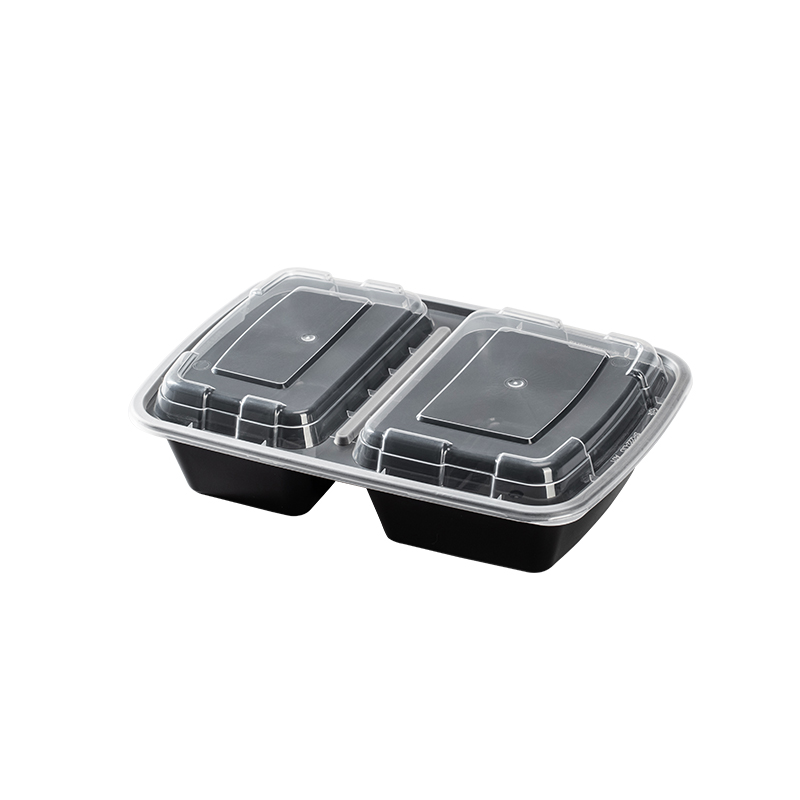 2-Compartment 12/15 oz Rectangular Compo Pack PL-9288A 12/15 oz two-compartment rectangular tray for comparing menu sizes; verify filled volume per cavity rather than relying on total capacity.View Product →
Capacity and Compartment Ratio: Read the Split, Not Just the Volume
The capacity printed on a specification sheet is the total, not the usable fill. A 16oz two-compartment tray does not hold 16oz of crackers and dip; it holds roughly what fits below the lid line once the divider and the closing rim take their share. Two rules keep quoting accurate. First, ask what the stated figure refers to, since "10/16oz" style naming often describes a combo pack rather than one single volume. Second, ask for a filled-volume figure per cavity, measured with a representative product rather than water.
| Reference | Total capacity | Cavity layout and shape | Typical fit |
|---|---|---|---|
| PR288 rectangular combo pack | 10oz to 16oz | Two compartments, rectangular | Dip and dippers, small savoury or sweet snack portions |
| PL288 ripple combo pack | 10oz to 16oz | Two compartments, rectangular, ripple wall | Same fills where grip and condensation handling matter |
| SR222 rectangular combo pack | 28oz | Two compartments, rectangular | Rice or pasta plus protein, larger lunch-box style packs |
| Three-compartment alternatives | 24oz and upward | Three compartments, rectangular or round | Menus that need a third separation instead of a second pack |
A quick sense check before sampling: a two-compartment split of roughly 40/60 suits dips and dippers, while an even split works better for two solid components of similar weight. Uneven splits look efficient on paper but leave one cavity half empty in the pack, which customers notice immediately.
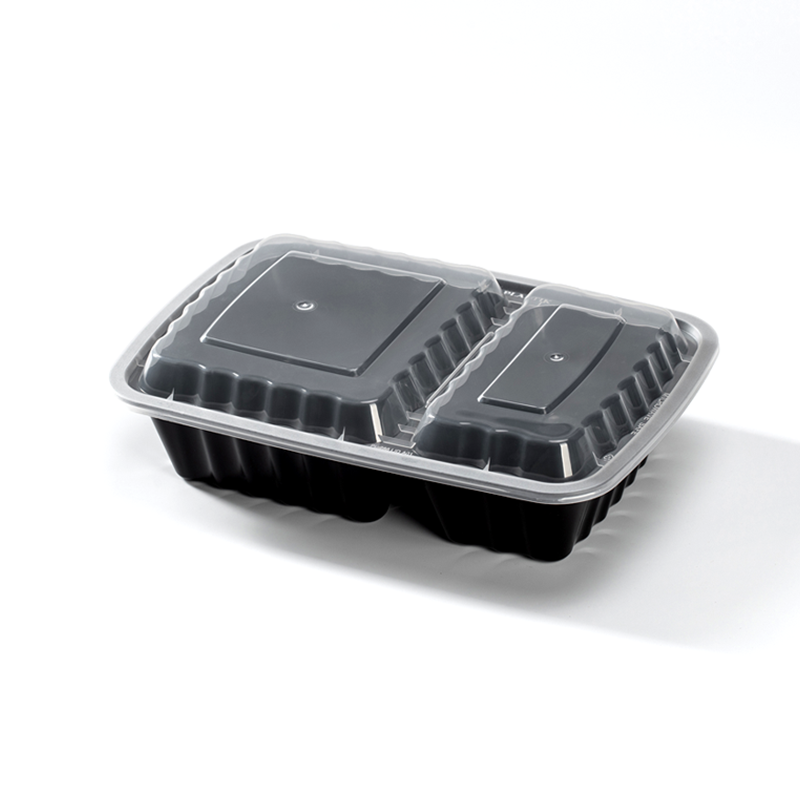 2-Compartment 10/16 oz Rectangular Compo Pack PR-288The 10/16 oz PR-288 rectangular two-compartment pack is worth reviewing when comparing cavity split and checking rim and divider fit.View Product →
Leak Behaviour Sits in the Rim and the Lid, Not the Divider
Cross-contamination in a two-compartment container almost never starts at the divider. It starts at the rim. A divider that stops below the fill line lets brine, oil or yoghurt slide across the top of the contents during handling, and a lid that closes firmly but does not seat evenly will pass liquid through the gap where the closing force is lowest.
What to check on a sample
- Fill each cavity with real product, close the lid, then invert the container for 30 seconds over a white surface.
- Repeat after two hours at chilled temperature and again after a short warm hold, because materials move differently at different temperatures.
- Run a light pressure test across the rim rather than only at the corners; uneven seating is the usual culprit.
- Confirm the divider height relative to your intended fill, not relative to the container's total depth.
Where the filled pack will sit in a delivery bag or be handled by customers, a ripple wall helps: it stiffens the sidewalls, improves grip and gives condensation somewhere to sit rather than running straight onto the label or the customer's hand. The ripple version keeps the same cavity layout, so a menu can move between the two without a new fill line or new lidding equipment.
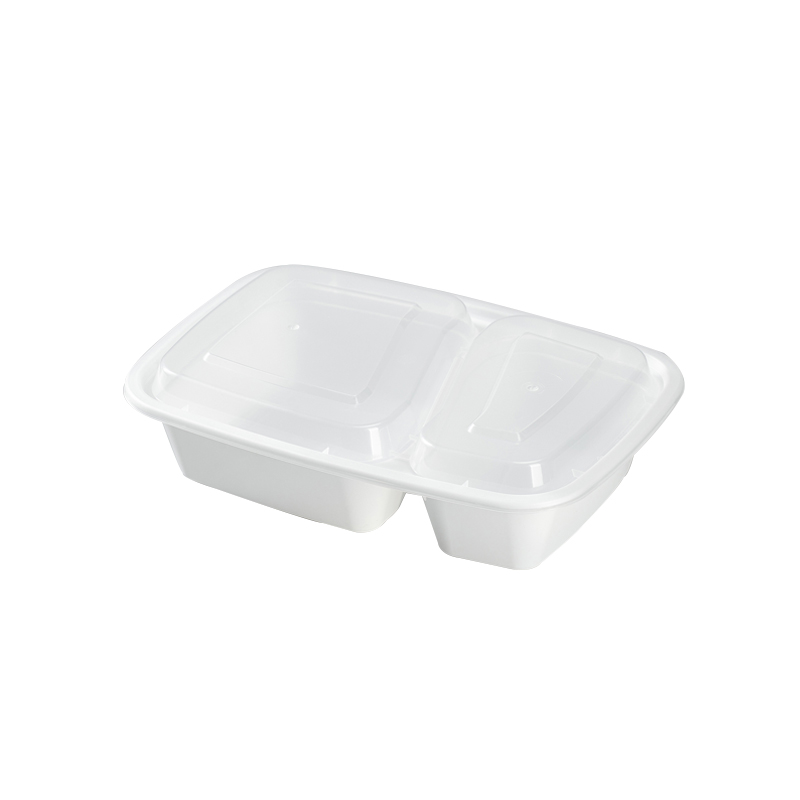 2-Compartment 10/16 oz Rectangular Compo Pack PL-288The PL-288 10/16 oz two-compartment tray is worth reviewing when comparing the same cavity layout in ripple-wall form and matching material to fill temperature.View Product →
Material Choices and Their Practical Trade-offs
Polypropylene is the usual choice for compartment trays because it generally handles warm fills and reheating better than PET, and it tolerates the flexing that snap-fit lids demand. PET keeps its advantage in cold applications: clear cold cups, cold snack cups and chilled dessert formats where visibility sells the product. Neither material is right in every case, and the decision should follow the fill temperature and the reheat instruction you intend to print.
Paper-based options shift the conversation towards a fibre-forward look. Kraft salad boxes with a PLA or PET window, square paper food boxes with PP or wire handles, and bagasse soup cups with board or PLA lids all cover snack-adjacent formats, and they can sit next to a plastic two-compartment tray in the same menu without looking mismatched. The practical caution is function, not appearance: fibre formats are less forgiving with wet components, so a dip is usually better placed in a lined or lidded cavity than directly against an uncoated board surface. For a full view of the moulded tray options, browse the plastic compartment container range before mixing materials in one pack.
Bulk Order Checks Before You Commit
Most sourcing problems on compartment trays are specification problems that surface after the first pallet, not manufacturing defects. These checks are cheap to run at sample stage and expensive to run afterwards.
- Confirm which cavity a stated capacity refers to, and get the figure per compartment in writing.
- Ask for a lid-fit test after a real shipment, not just at the factory bench, since vibration and stacking change how a lid seats.
- Verify divider height against your actual fill line, not against the container's nominal depth.
- Check nesting and stacking height in your display case or delivery bag before approving the mould.
- Confirm the case pack, and whether the lid is supplied in the same carton as the base.
- Keep one reference sample of every approved size, so a replacement shipment has something physical to match.
Sample books and physical samples are the fastest way to close these questions, and the team can be reached through the contact page.
Frequently Asked Questions
Are two-compartment snack containers suitable for reheating?
It depends on the material. Polypropylene trays are the usual choice where a reheat instruction will be printed, while PET formats should stay with cold fills. Confirm the intended use with your supplier and match the printed instruction to the material actually supplied.
What sizes are available in a two-compartment layout?
Common references include 10oz to 16oz rectangular combo packs and a 28oz rectangular combo pack, with two-compartment layouts also appearing alongside three-compartment and five-compartment variants in the same product family.
Can both compartments hold liquid?
Only if the lid seals across the full rim, including the divider junction. Test with the real product at the temperature it will actually be stored at; water alone will pass a test that a thin oil or a brine will fail.
Can I use a lid from a different size?
No. Combo packs are moulded as matched pairs, and a lid from another capacity will either fail to seat or seat with uneven pressure, which is exactly the condition that lets liquid cross compartments.
The short version: choose the split by the wet component, choose the total capacity by the filled volume below the lid line, and choose the lid by how the pack will be handled after it leaves the counter. A two-compartment snack container is a simple object with a short specification list, and getting those three items right removes most of the complaints that arrive later.
Share:
Related Products

We are very glad that you came to JIEYU to purchase or customize, and we are confident to provide you with quality products and services.

We are committed to developing innovative, reliable, economical, and environmentally friendly disposable and reusable food service products for our customers.

No.199 Liansheng Road, Coast Business Center, Yinzhou District, Ningbo, Zhejiang, China

+86-18106622299

jay@jieyuplast.com
