
 English
  中文简体
中文简体


Why Paper Containers Are Dominating the Global Food Packaging Industry in 2026
May 15, 2026
Content
- 1 Policy Drivers: Global Plastic Bans Accelerate Paper Container Adoption
- 2 Technological Breakthroughs: Modern Paper Containers Are No Longer Traditional Paper Products
- 3 Application Scenarios: Full-channel Coverage from Takeaway to Retail
- 4 Supply Chain Transformation: Wholesale Models Reshape Industry Landscape
- 5 Environmental Value: Full Lifecycle Carbon Footprint Comparison
- 6 Future Trends: Intelligence and Functionality Advance Together
Paper containers are rapidly replacing traditional plastic packaging to become the core solution in the global food packaging industry. According to industry data, the global paper-based food packaging market is expected to exceed $120 billion by 2028, with a compound annual growth rate maintaining above 6.5%. This transformation is jointly driven by tightening environmental policies, shifting consumer preferences, and continuous breakthroughs in the functionality of paper containers. Whether for takeaway meal boxes, fast food packaging, or disposable tableware, paper-based materials have become the preferred choice for restaurants, supermarkets, and food manufacturers.
Policy Drivers: Global Plastic Bans Accelerate Paper Container Adoption
Governments worldwide have introduced plastic restriction policies, directly fueling the explosive growth of the paper container market. The EU banned the sale of disposable plastic cutlery, straws, and meal boxes starting in 2021; China implemented its "strictest ever plastic restriction order" in 2020, explicitly prohibiting non-degradable disposable plastic tableware in major cities; multiple U.S. states have also passed similar regulations. These policies have compelled manufacturers of disposable food containers and takeaway food containers to accelerate their transition to paper-based materials.
Major Market Plastic Ban Policy Timeline
| Region | Effective Date | Banned Items |
|---|---|---|
| European Union | July 2021 | Disposable plastic cutlery, straws, meal boxes |
| China | January 2020 | Non-degradable disposable plastic tableware |
| California, USA | January 2022 | Foam plastic food containers |
| India | July 2022 | Selected disposable plastic products |
| United Kingdom | October 2023 | Disposable plastic cutlery, trays |
The strict enforcement of these policies has forced structural adjustments in the disposable packaging industry. Taking the Chinese market as an example, the usage of paper-based takeaway packaging increased by over 35% year-on-year in 2023, while plastic takeaway packaging usage declined by nearly 20%. This seesaw trend is prevalent globally.
Technological Breakthroughs: Modern Paper Containers Are No Longer Traditional Paper Products
Early paper containers suffered from poor water and oil resistance and weak load-bearing capacity, making them unsuitable for packaging hot food, soups, and fried items. However, recent innovations in material lamination technology and coating processes have brought qualitative leaps to modern paper containers. Food packaging boxes now commonly utilize PE, PLA, or aqueous coatings, providing excellent oil-proof, waterproof, and high-temperature resistant properties.
Key Technological Innovation Points
- Multi-layer Composite Structure: Utilizing a three-layer structure of kraft paper + aluminum foil + PE film, enabling paper meal boxes to withstand temperatures up to 120°C, suitable for microwave heating
- Plant-based Waterproof Coating: Replacing traditional plastic coatings with corn starch or sugarcane extracts to achieve complete biodegradability, with degradation cycles shortened to within 90 days
- High-strength Corrugated Design: Enhancing the load-bearing capacity of paper trays through micro-corrugation technology, with single-layer trays capable of carrying over 2 kg of food
- Precision Die-cutting Process: Achieving zero liquid leakage standards after folding, meeting the requirements for soup cups, salad bowls, and other applications
These technological advancements have expanded the application scenarios of paper meal boxes and disposable tableware from simple cold food packaging to full-category food coverage, including hot soups, fried foods, and baked products.
Application Scenarios: Full-channel Coverage from Takeaway to Retail
Paper container applications have penetrated every segment of the food industry. Delivery food containers represent the fastest-growing market segment, with the global takeaway market reaching $154 billion in 2023, of which over 70% of orders use paper-based packaging. The fast food industry is also a major consumer of paper containers, with paper-based materials accounting for over 60% of fast food packaging.
| Application Field | Market Share | Typical Products | Growth Trend |
|---|---|---|---|
| Takeaway Delivery | 32% | Takeaway meal boxes, soup cups | +18% annually |
| Fast Food Chains | 28% | Burger boxes, fry cartons | +12% annually |
| Bakery & Desserts | 15% | Cake boxes, paper cups | +15% annually |
| Coffee & Beverages | 14% | Paper cups, cup sleeves | +20% annually |
| Supermarket Retail | 11% | Salad bowls, trays | +10% annually |
Notably, the substitution trend for disposable cups and plastic cups is particularly pronounced. Globally, approximately 500 billion disposable cups are consumed annually, with the share of paper cups increasing from 45% in 2018 to 62% in 2023. The comprehensive paper cup transition by coffee chain brands has been a significant driving force behind this shift.
Supply Chain Transformation: Wholesale Models Reshape Industry Landscape
The wholesale disposable food container business is undergoing dual transformation through digitalization and centralization. Traditional fragmented procurement models are gradually being replaced by B2B e-commerce platforms, while large catering groups prefer establishing direct partnerships with manufacturers to obtain customized services and scale cost advantages. Data shows that global B2B e-commerce transaction volume for food packaging grew by 42% year-on-year in 2023, with paper containers occupying the largest share.
Three Key Directions for Supply Chain Optimization
- Customized Production: Manufacturers provide full-process customization from dimensions and materials to printing, with minimum order quantities reduced to 5,000 units, meeting the personalized needs of small and medium-sized catering enterprises
- Intelligent Warehousing: Real-time inventory monitoring through RFID and IoT technologies, shortening delivery cycles from the traditional 15 days to 5-7 days
- Green Logistics: Adopting recyclable packaging materials and new energy transportation tools to reduce supply chain carbon footprints and meet ESG compliance requirements
For purchasers of one time use containers, these transformations mean higher efficiency, lower costs, and more flexible cooperation models. Leading manufacturers in the industry have achieved capacity utilization rates above 85%, with scale effects further reducing unit production costs.
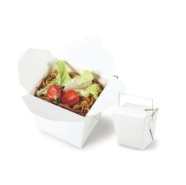
Environmental Value: Full Lifecycle Carbon Footprint Comparison
The environmental advantages of paper containers extend beyond biodegradability to encompass full lifecycle carbon emission control. According to Life Cycle Assessment (LCA) studies, paper-based food packaging has a carbon footprint approximately 40% lower than traditional plastic packaging. This is primarily attributed to three factors: the renewability of raw materials, lower energy consumption during production, and ease of recycling after disposal.
Environmental Indicator Comparison: Paper Containers vs. Plastic Packaging
| Assessment Indicator | Paper Container | Plastic Packaging | Difference |
|---|---|---|---|
| Carbon Emissions (kg CO2e/kg) | 0.94 | 1.58 | -40.5% |
| Energy Consumption (MJ/kg) | 28.5 | 42.3 | -32.6% |
| Degradation Period | 2-6 months | 450+ years | Significant advantage |
| Recycling Rate | 68% | 9% | +59 percentage points |
| Raw Material Renewability | 100% | 0% (petroleum-based) | Fundamental difference |
These data indicate that choosing paper containers is not merely a compliance requirement but an effective way for enterprises to fulfill social responsibility and enhance brand image. Over 73% of consumers express willingness to pay a 5%-10% premium for eco-friendly packaging, providing clear market returns for businesses using paper containers.
Future Trends: Intelligence and Functionality Advance Together
The paper container industry is evolving deeply in both intelligent and functional directions. Smart packaging technologies are being integrated into paper container designs, such as built-in temperature sensing labels that display food freshness in real-time, and QR code integration for full supply chain traceability. In terms of functionality, innovative products such as antimicrobial paper containers and self-heating paper meal boxes have entered market testing phases.
Key Industry Trend Predictions for 2024-2028
- Accelerated Plastic-free Transition: By 2026, 80% of disposable food packaging in major global markets will achieve plastic-free status, with aqueous coatings and plant-based materials becoming mainstream
- Lightweight Design: Through structural optimization and material upgrades, the average weight of paper containers will decrease by 20%, reducing transportation costs and raw material consumption
- Personalized Customization: The proliferation of digital printing technology will reduce the cost of small-batch, multi-pattern customization by 60%, empowering small and medium brands to differentiate competitively
- Closed-loop Recycling System: Establishing a paper container recycling and reuse system from consumer end to production end, targeting 50% recycled pulp utilization rate by 2030
For food enterprises and packaging purchasers, keeping pace with these trends means gaining advantages in compliance, cost control, and market competitiveness. Paper containers have evolved from simple alternatives to become the core engine driving sustainable development in the food packaging industry.
Share:
Related Products

We are very glad that you came to JIEYU to purchase or customize, and we are confident to provide you with quality products and services.

We are committed to developing innovative, reliable, economical, and environmentally friendly disposable and reusable food service products for our customers.

No.199 Liansheng Road, Coast Business Center, Yinzhou District, Ningbo, Zhejiang, China

+86-18106622299

jay@jieyuplast.com
