
 English
  中文简体
中文简体


What Does Compostable Packaging Really Mean? Standards, Limits, and Buyer Tips
Oct 16, 2026
Content
- 1 What Compostable Packaging Really Means, Precisely
- 2 Compostable, Biodegradable and Recyclable Are Not the Same Promise
- 3 Why Compostable Packaging Still Ends Up in Landfill
- 4 What This Means for Foodservice Buyers
- 5 The Materials Behind Compostable Food Packaging
- 6 A Five-Step Verification Routine
- 7 Frequently Asked Questions
A restaurant moves 30,000 meals a month into moulded fibre clamshells stamped "compostable", tells guests the change is greener, and later learns that the city hauler sends all of it to landfill because the nearest commercial composting site is 200 km away. Nothing on the label was false. The claim simply described narrower conditions than the buyer assumed.
That gap is what compostable packaging really means: a claim about a specified environment, a specified time frame and a specified level of breakdown, verified against a test standard. It is not a general promise that an item will disappear in a hedgerow, a home bin, a river or a landfill.
What follows covers the standards behind the word, how it differs from biodegradable and recyclable, where compostable items actually end up, and what to verify before you commit a year of packaging budget.
What Compostable Packaging Really Means, Precisely
Compostable material breaks down through biological processes into carbon dioxide, water, inorganic compounds and biomass, at a rate consistent with other known compostable materials, leaving no visually distinguishable residue and no toxic leftovers. That definition only becomes checkable when it is tied to a standard.
The standards that matter in most export markets:
- EN 13432: the European benchmark for packaging recoverable through composting and anaerobic digestion.
- ASTM D6400: the US equivalent for plastics designed for aerobic composting.
- AS 4736: industrial composting in Australia.
- AS 5810: the home composting counterpart, tested at ambient temperature.
The numbers behind EN 13432 and ASTM D6400 are the numbers a buyer actually pays for:
- At least 90% biodegradation within 6 months, measured as carbon converted to CO2.
- Disintegration within 12 weeks, with no more than 10% of the original dry weight passing a 2 mm sieve.
- No adverse effect on the composting process, plus heavy metal limits and an ecotoxicity test on the finished compost.
Industrial and home composting are two different claims
Industrial composting holds material at roughly 55-60 °C with controlled moisture and aeration for about 12 weeks. A home heap sits nearer 20-30 °C, gets turned irregularly and can dry out in summer. A fibre clamshell that disappears in an industrial windrow in eight weeks may sit recognisable in a garden bin for a year. If your operation cannot guarantee an industrial stream, a home compostable certification is the only claim that matches your reality.
Compostable, Biodegradable and Recyclable Are Not the Same Promise
These three words are used interchangeably in sales decks and are not interchangeable on a purchase order.
| Claim on the pack | What it requires | Typical conditions | Certification |
|---|---|---|---|
| Compostable | Controlled biological breakdown into CO2, water and biomass, with limits on time and residue | Industrial windrow at 55-60 °C for about 12 weeks, or a defined home setup | EN 13432, ASTM D6400, AS 4736; AS 5810 for home |
| Biodegradable | Breakdown by microorganisms, with no stated time frame or residue limit | Anywhere, eventually, including landfill over decades | None required |
| Bio-based | Feedstock grown from plants rather than oil | No end-of-life requirement at all | None required |
| Recyclable fibre | Fibre recovery at a paper mill, clean and dry | Curbside or back-of-house collection | No single international mark |
| Recyclable PET | A consistent stream of clear PET free of PLA | Deposit or bottle-to-bottle systems | Resin identification code |
The practical consequence: a compostable fork is not recyclable, and a recyclable PET cup is not compostable. Dropping both into the same front-of-house bin destroys the value of both streams.
Why Compostable Packaging Still Ends Up in Landfill
- Infrastructure: only a minority of cities run separate organics collection that accepts packaging as well as food waste.
- Screening: many organics programmes accept food scraps only, because operators cannot separate lookalike conventional plastic at the tipping floor.
- Contamination: a PLA straw in a PET bale is contamination, and so is a compostable cup in mixed recycling.
- Coatings and windows: board with a hidden PE coating or a PET window is not compostable, whatever the paper underneath is.
- PFAS: some moulded fibre formats have historically used grease-resistant chemistry that is incompatible with compost quality, so ask for a declaration.
- Storage: bioplastic articles soften in hot warehouses and absorb moisture, so shelf life and stock rotation matter.
What This Means for Foodservice Buyers
Buy compostable packaging only where you have, or will have, a route to the organics stream it needs, and buy it as a complete, certified article rather than as a material. Four checks do most of the work:
- Certification, not adjectives: ask which standard, which certificate number, and whether the certificate names the exact article, lid and window film.
- Temperature fit: PLA softens around 50-60 °C, so it suits cold and ambient items far better than soup held under a heat lamp.
- Whole-assembly consistency: a compostable bowl with a conventional lid is not a compostable pack.
- Unit economics: expect a 15-40% premium over conventional plastic, plus possible changes to storage and rotation.
Hot and wet menu items usually point buyers toward bagasse fibre rather than coated board, because the pulp handles heat and moisture without a plastic film, which is the material direction set out on our sustainable packaging page.
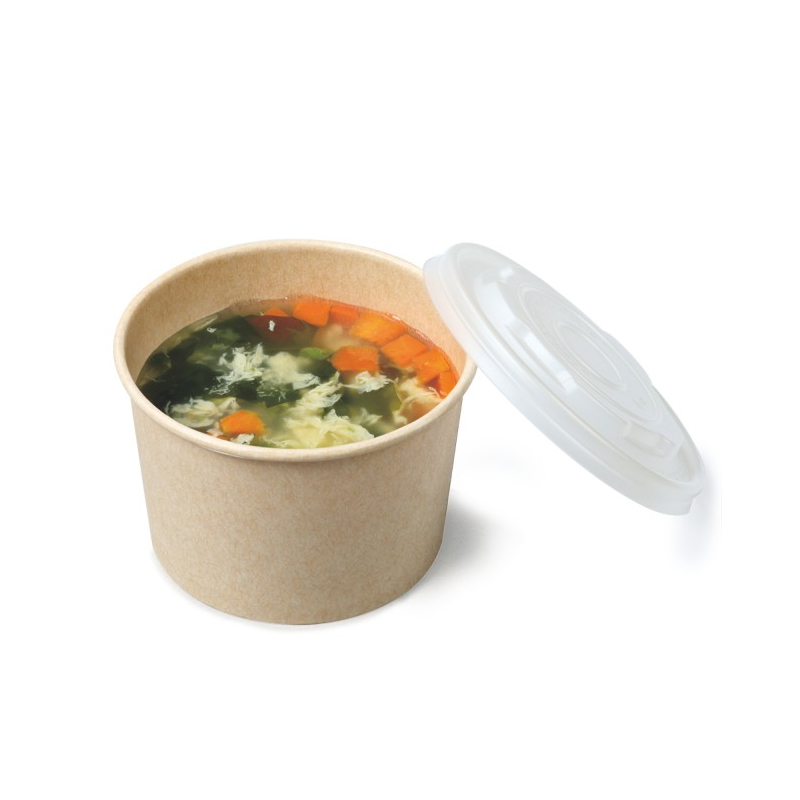 Custom Bagasse Paper Soup Cup SeriesSix-model bagasse paper soup cup line with top diameters from 90 mm to 118 mm, relevant for hot and wet menu items.View Product →
Once the disposal route is settled, the material decision becomes straightforward. Without it, even a correctly certified product is just a more expensive landfill item.
The Materials Behind Compostable Food Packaging
Moulded fibre and bagasse
Sugarcane pulp and recycled fibre are pressed into bowls, clamshells and trays with no plastic film at all. They tolerate hot, oily and saucy foods, which is why they dominate soup and hot-meal formats. Plain fibre is not grease-proof on its own, so ask how that property is achieved.
Paper and board with a compostable window
Kraft board with a PLA window keeps a cold salad visible without switching to all-plastic packaging, and the whole pack can be certified as one item. Note the trade-off: a PLA window makes the pack compostable but normally rules out fibre recycling.
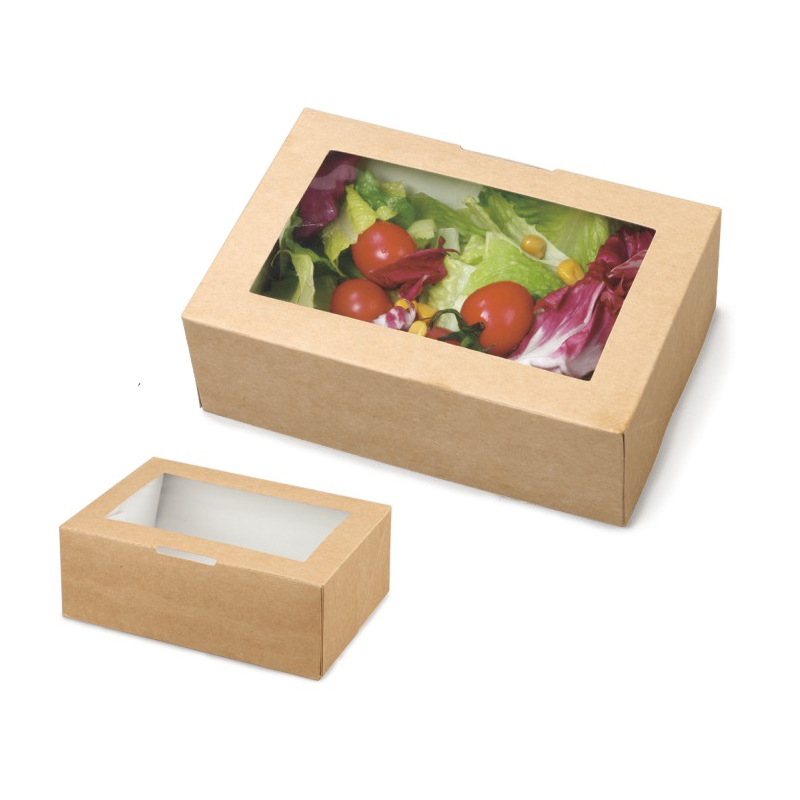 Kraft Paper Salad Box with PLA WindowKraft paper box with PLA window, offered in three models with 60 mm height and case pack of 600, for visible cold salad packaging.View Product →
Bioplastic and fibre straws
PLA and CPLA work well for cold drinks, cutlery and lids, though they need industrial conditions. Straws blended from bamboo or wood fibre with paper hold their shape longer in a drink than plain paper, and solid-colour versions avoid the soggy look customers notice first.
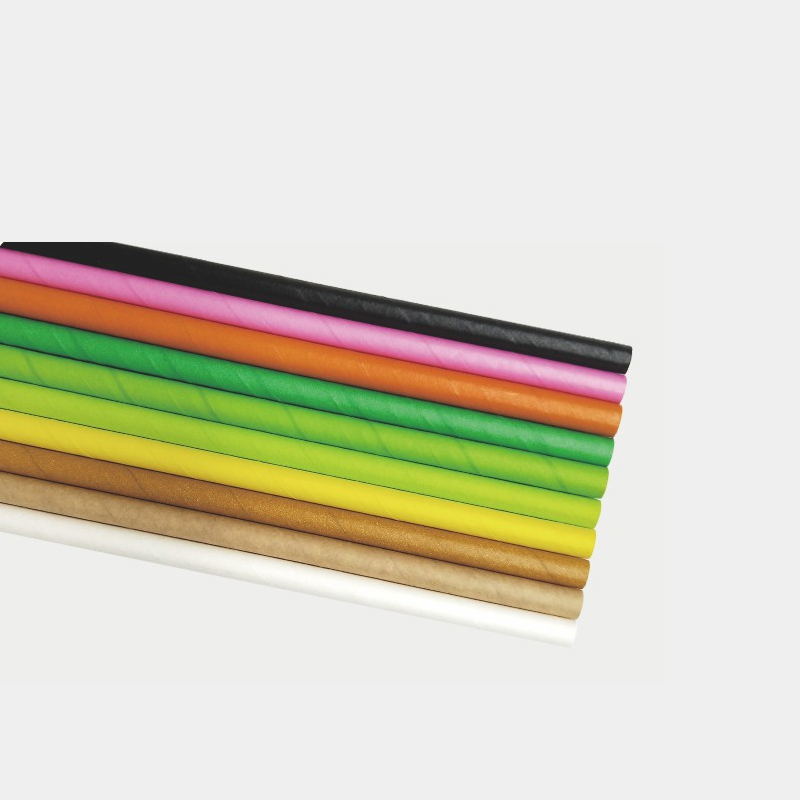 Solid Color Bamboo and Wood Fiber Paper StrawsSolid-colour paper straws made with bamboo or wood fibre, in ten colors and 500×10 case packs, for comparing fibre and print before mould commitment.View Product →
A Five-Step Verification Routine
- Request the certificate itself, not a screenshot of a logo, and note the standard number and expiry date.
- Check that the certificate lists the exact article, capacity and lid, because approvals are granted per item rather than per factory.
- Trace the full assembly: container, lid, window film, straw, cutlery and any printed label.
- Confirm the disposal route in writing with your waste contractor before the first pallet arrives.
- Run a 30-day pilot on one or two menu lines and brief staff on which bin each item goes into.
Samples make the first two steps much faster, and a sample book lets you compare fibre weight, lid fit and print quality before you commit to a mould.
Frequently Asked Questions
Does compostable packaging break down in landfill?
No, not in any useful time frame. Landfills are engineered to be dry and oxygen-poor, which is close to the opposite of composting conditions.
Can compostable packaging be recycled instead?
Usually not. PLA contaminates PET recycling, and fibre with a window or film coating complicates paper recovery. Compostable packaging is made for the organics bin.
Is a paper cup with a plastic lining compostable?
Not if the lining is PE. A cup lined with PLA film can be certified under EN 13432 or ASTM D6400, so the lining chemistry, not the word "paper", decides the claim.
Why does compostable packaging cost more?
Smaller production volumes, more expensive resins and pulp, and tighter process windows. A 15-40% premium over conventional plastic is normal in most markets.
Compostable packaging means one specific thing: a certified material that breaks down within a defined time, in a defined environment, leaving compost that is safe to use. Whether that claim delivers environmental value depends less on the label and more on the bin it lands in, and on the questions you ask before signing the order.
Share:
Related Products

We are very glad that you came to JIEYU to purchase or customize, and we are confident to provide you with quality products and services.

We are committed to developing innovative, reliable, economical, and environmentally friendly disposable and reusable food service products for our customers.

No.199 Liansheng Road, Coast Business Center, Yinzhou District, Ningbo, Zhejiang, China

+86-18106622299

jay@jieyuplast.com
